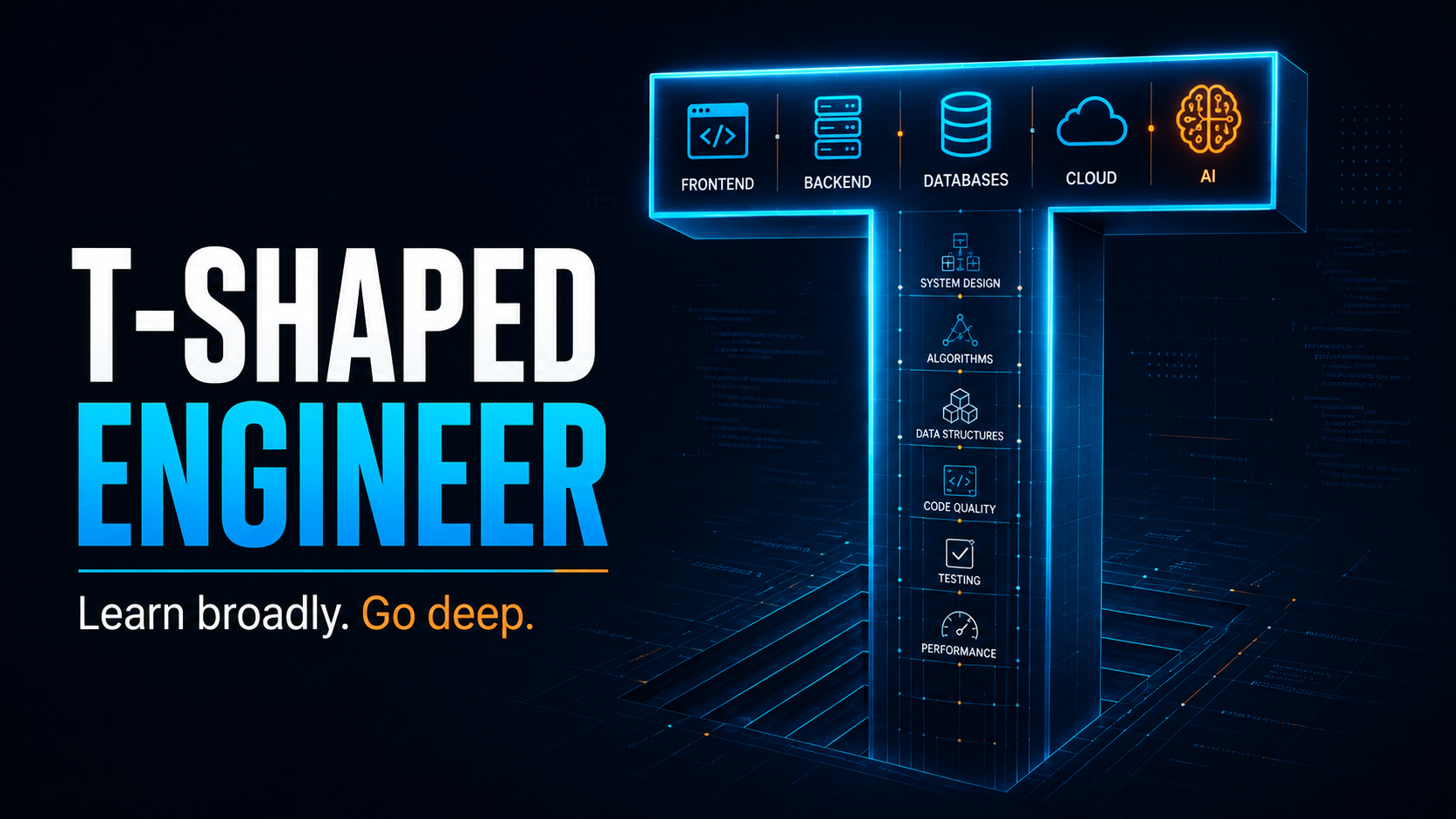
I Tried to Learn Everything. Then I Discovered the T-Shaped Engineer.
I thought becoming a better engineer meant learning every new technology. It made me broader, but not necessarily better. The T-shaped model gave me a clearer way to grow: understand the whole system, then choose where to go deep.
For a while, my learning plan looked impressive.
Frontend. Backend. Mobile. Cloud. DevOps. AI.
Every time I discovered a new technology, I felt I should learn that too. I was moving constantly, but one question kept getting harder to answer:
What am I actually becoming great at?
That is when I came across the idea of a T-shaped engineer.
It did not tell me to stop exploring. It simply gave that exploration a direction.

The shape is simple. The lesson is not.
The horizontal line of the T is your breadth.
It means understanding enough about frontend, backend, databases, deployment, security, product, and the business to see how the complete system works. You can collaborate outside your main area, follow technical conversations, and recognize when a problem needs someone with deeper expertise.
The vertical line is your depth.
This is the area where you do more than follow tutorials. You understand why things work, what breaks under pressure, which trade-offs matter, and how to debug problems that do not have an obvious Stack Overflow answer.
A backend engineer, for example, may still build a reasonable interface and deploy an application. But when an API becomes slow, data consistency breaks, or an architecture decision becomes expensive, backend depth is where that engineer becomes especially valuable.
Breadth helps you connect the system. Depth helps you carry its hardest problems.

The trap I was falling into
There are two easier shapes.
An I-shaped engineer goes very deep but struggles to work outside one narrow area.
A dash-shaped engineer knows a little about many things but has no area where others can truly depend on them.
The second one is especially easy to become today. A few courses, several frameworks, AI-generated code, and a long list of technologies can create the feeling of progress. But depth appears only when the abstraction stops working: production fails, performance drops, requirements conflict, or the obvious solution is too expensive.
That realization changed how I now think about learning. I do not need to master everything I touch. Some subjects belong on the horizontal line. One area must keep growing downward.
How I am building my T
My approach is becoming simpler:
- Choose depth from real work. Notice which problems you repeatedly enjoy solving, not only which technology is currently popular.
- Go three layers deeper. Do not stop at how to use a tool. Ask how it works internally, why it was designed that way, and when it is the wrong choice.
- Use breadth to remove blind spots. Learn enough security, databases, deployment, product, and business to understand the consequences of your decisions.
- Build and operate real systems. Difficult bugs, failed deployments, performance issues, and user constraints teach depth faster than another beginner tutorial.
- Redraw your T every few months. Your specialization can evolve. The purpose is direction, not a permanent label.
I am still building mine. That is exactly why this model matters to me: it turns an endless list of things to learn into a deliberate path.
So maybe the question is not, “Which technology should I learn next?”
Maybe it is:
Will this make my T broader—or take my strongest skill deeper?
And if you drew your T today, what would you write on its vertical line?
Further reading
Subscribe to Updates
Get notified about new projects and articles.
Comments
Loading comments...